Owner-Builder Education
Can You Be Your Own General Contractor in Arizona?
Arizona may allow you to build your own home. Before you finalize plans, contracts, or financing, understand the different legal, project-management, and lender-approval questions an owner-builder project raises.
By Matthew Siket, NMLS #442558 · September 12, 2026 · 15 min read
Building your own home can create an appealing opportunity to control the budget, select subcontractors and manage the construction schedule. But before deciding to act as your own general contractor in Arizona, it is important to separate three different questions:
- Does Arizona law allow it?
- Can you document and manage the project properly?
- Will your construction lender approve the arrangement?
Those are not the same question. State law may allow an individual owner to manage construction personally, while a construction lender may use a much more specific definition of an acceptable “owner-builder.” Licensing must then be evaluated under the law of the state and locality where the home will be built.
The central distinction is simple:

Arizona’s owner-builder exemption addresses whether an owner may legally build or improve the owner’s property without personally holding a contractor’s license. It says nothing about whether a bank or credit union must finance the project, accept the proposed agreement, disburse draws to the owner or assume the additional construction risk.
Owner-builder construction loans are offered by relatively few financial institutions. When a lender does offer one, it may require much more than legal eligibility—including an established construction business, recent relevant experience, an acceptable construction agreement, adequate insurance, reliable cost documentation and a workable method for controlling draws and lien risk.
“Owner-builder” can mean two different things
This distinction should be made before plans, contracts or financing are finalized.
The legal meaning
Under a state’s owner-builder rules, an individual property owner may be permitted to manage construction of the owner’s residence without holding a general-contractor license personally. The conditions and available exemptions vary by state.
The construction-loan meaning
For purposes of some construction-loan programs, an acceptable owner-builder is a borrower who owns an established construction company and uses that company as the builder of the borrower’s home. The borrower-owned company signs a complete construction agreement, receives the construction draws and accepts responsibility for the project’s scope, budget, subcontractors, schedule, lien documentation and completion.
The builder does not necessarily need to be an independent third party. A related construction company owned by the borrower may be acceptable when it:
- Is a legitimate operating construction business;
- Demonstrates sufficient recent and relevant experience;
- Signs a complete construction agreement as the builder;
- Holds every contractor license required by the project state and locality;
- Carries the insurance required by the lender and applicable law; and
- Can administer the subcontractors, draws and lien documentation.
This state-specific licensing language matters. In Arizona, the borrower-owned building company will generally need the applicable Arizona Registrar of Contractors license when it undertakes or manages construction as a contractor. Texas generally does not issue a statewide general-contractor license, although local registration and permits may apply and regulated trades remain subject to their own licensing requirements.
What if the borrower does not own a construction company?
The borrower still may be legally permitted to self-fund and manage the project under the applicable state’s owner-builder rules. In Arizona, that may be possible when the statutory exemption is satisfied.
For construction-loan purposes, however, an individual who does not have an established construction company—or cannot qualify to act as the approved builder—cannot create the required builder relationship merely by writing “Construction Contract” at the top of a document.
If the borrower plans to coordinate the project while retaining the individual trade contracts, payment obligations, cost risk and completion responsibility, the arrangement functions more like an owner-managed construction plan or construction-management arrangement. Under the lending definition used in this article, it is not the equivalent of a complete construction agreement with an approved builder.
The borrower could instead hire an acceptable independent GC. In that case, the GC—not the borrower—would sign the complete construction agreement and serve as the builder.
There is no universal construction contract
Construction agreements vary widely. Some are two-page documents with little more than a price and general description. Others use extensive American Institute of Architects forms containing detailed provisions, exhibits and defined responsibilities.
Either extreme can create problems. A very short agreement may omit critical terms. A complex industry form may contain provisions that the parties do not understand, fail to complete properly or modify in ways that create internal conflicts.
The document’s length, title or template does not determine whether it is acceptable. The agreement must clearly explain—for the owner, builder and lender:
- The exact parties and correct legal names;
- Who is serving as the builder;
- Whether the builder is independent or borrower-owned;
- The property and approved plans and specifications;
- The complete scope of construction;
- The contract price and treatment of allowances;
- Fixed-price, cost-plus or other pricing terms;
- Deposits and borrower-paid items;
- Start date and anticipated completion date;
- Draw schedule and conditions for payment;
- Who contracts with and pays the subcontractors;
- Responsibility for permits, inspections and code compliance;
- Required insurance;
- Change-order procedures;
- Responsibility for cost overruns;
- Lien-waiver and payment documentation;
- Default, termination and dispute provisions; and
- Who remains legally responsible for completing the home.
Caveat emptor—buyer beware. Do not assume that a document is a complete construction agreement merely because the heading says “Construction Contract.” Read what it actually requires each party to do. The owner and lender both need enough detail to understand how the project will be built, paid for and completed.
Does Arizona require a general contractor to be licensed?
Generally, yes. Arizona law prohibits a person or company from acting or offering to act as a contractor without an active contractor’s license unless a statutory exemption applies.
Arizona’s definition of a contractor is broad. It includes a person or company that, for compensation, undertakes construction or directly or indirectly supervises others. It also includes consultants who represent that they can manage a construction project for an owner, including hiring or firing specialty contractors, scheduling work and selecting or purchasing construction materials.
That means changing the title from “general contractor” to “construction manager” does not necessarily avoid Arizona’s licensing requirements. If a third party is being paid to manage construction for the owner, that person or company may legally be acting as a contractor.
Arizona references: A.R.S. § 32-1101 and A.R.S. § 32-1151.
What is Arizona’s owner-builder exemption?
Arizona law provides an exemption for owners who build or improve property intended for their own occupancy. Under the exemption, the owner may:
- Perform the work personally;
- Use the owner’s own wage-paid employees; or
- Contract with duly licensed contractors.
The property must be intended for the owner’s occupancy and not for sale or rent. A sale, rental or offer for sale or rent within one year after completion or issuance of a certificate of occupancy can create a legal presumption that the project was undertaken for sale or rent.
The exemption means a qualifying Arizona property owner does not automatically need to hold a general-contractor license to manage the construction of the owner’s future residence.
It does not mean an unlicensed third-party construction manager can step into the role of a general contractor. It also does not eliminate applicable licensing requirements for contractors hired to perform the work.
Arizona reference: A.R.S. § 32-1121(A)(5).
What does “duly licensed” mean?
The statute says “duly licensed,” not “dually licensed.” Duly licensed generally means that the contractor is properly licensed for the work being performed.
For an owner-builder project, that ordinarily means confirming that each contracting company:
- Has an active Arizona Registrar of Contractors license;
- Holds the correct classification for its scope of work;
- Uses the same legal name on its license, contract and payment documentation; and
- Maintains its license while performing the work.
Depending on the project, separate contractors may be needed for excavation, concrete, framing, roofing, electrical, plumbing, HVAC, insulation, drywall and other work.
The individual employees of a properly licensed subcontracting company do not ordinarily need separate contractor licenses. The company contracting to perform the work must have the appropriate license.
Can the under-$1,000 handyman exemption cover subcontractors?
It generally should not be treated as a way around licensing on a new-home project. Arizona’s limited exemption for casual or minor work under $1,000 does not apply when the work is part of a larger construction operation or when contracts are divided into smaller amounts to evade licensing requirements.
Arizona reference: A.R.S. § 32-1121(A)(14).
The practical owner-builder waterfall
1. Is there one approved builder operating under a complete construction agreement?
The builder may be an independent GC or an acceptable borrower-owned construction company. If there is one approved builder, the lender can generally evaluate one company, one primary construction contract, one budget, one insurance package and one party responsible for managing the subcontractors and completing the home.
2. If there is no licensed GC, does the owner qualify as an owner-builder?
The owner must satisfy Arizona’s statutory exemption and intend to occupy the completed property.
3. Who will perform the construction?
If the owner is not personally performing all the work or using wage-paid employees, the owner will normally contract directly with appropriately licensed trade contractors.
4. How many separate relationships must be reviewed?
Without one GC contract covering the entire build, the project may involve numerous direct contracts between the owner and individual trade contractors. Arizona requires contracts exceeding $1,000 between a contractor and property owner to contain specified information, including the contractor’s name, business address and license number; the work description; total contract amount; projected completion; deposit; and progress-payment schedule.
Arizona reference: A.R.S. § 32-1158.
5. Will the lender administer the project at the subcontractor level?
This is where a legally permissible owner-builder project can encounter a financing limitation. A lender may need to review multiple licenses, contracts, insurance certificates, scopes of work, budgets and draw requests rather than relying on one approved GC.
Some lenders are specifically structured for owner-builder financing. Others require a qualified licensed general contractor, particularly when the borrower lacks recent, verifiable construction-management experience.
Why an arm’s-length builder relationship matters to a construction lender
An arm’s-length transaction is an agreement between independent parties with separate economic interests. In a traditional construction arrangement:
- The owner promises to pay the contract price;
- The builder promises to complete the defined work;
- The builder accepts responsibility for the budget, schedule, subcontractors and completion; and
- Each party can enforce the agreement against the other.
When the borrower owns the building company, the construction contract is a related-party transaction rather than a fully arm’s-length transaction. That fact does not automatically disqualify it if the lender permits borrower-owned builders. The lender can instead evaluate whether the company is a real operating business, is properly licensed where required, has sufficient recent experience and accepts the complete contractual responsibilities of the builder.
Merely creating a new LLC and calling it the “builder” is different from using an established construction company. It does not establish experience, operating capacity, insurance or licensing. In Arizona, if the company undertakes, supervises or manages construction as a contractor, it may require the appropriate ROC license. Arizona looks at the services actually performed, not merely the name placed on the agreement.
Arizona reference: A.R.S. § 32-1101.
How owner-builder construction changes the draw process
Many construction-loan programs disburse draws to one approved builder. That builder submits a consolidated draw request, pays the subcontractors and suppliers, and provides the required lien documentation.
An individual owner-builder arrangement without an approved construction company changes that structure:
- Paying a draw to the borrower gives the same person control of both the loan proceeds and subcontractor payments;
- Paying each trade directly requires the lender or draw administrator to process numerous separate payments; and
- Paying a newly formed borrower-owned company does not eliminate related-party, licensing, experience or qualification concerns.
Without one approved GC, a lender may require a separate draw file for every contractor included in a payment request. Depending on the lender and title company, that file could include:
- Current state and local license or registration verification, including ROC verification in Arizona;
- The contractor’s agreement and approved scope;
- Invoice or payment application;
- Insurance certificate;
- Conditional progress lien waiver before disbursement;
- Evidence that payment cleared;
- Unconditional progress lien waiver after payment;
- Applicable preliminary 20-day notices;
- Change orders and an updated remaining-cost analysis; and
- Final lien releases when each trade completes its work.
Arizona prescribes forms for conditional and unconditional progress and final lien waivers. A purported waiver generally must substantially follow the applicable statutory form.
Arizona reference: A.R.S. § 33-1008.
Why Arizona lien law adds another layer
Arizona defines an “original contractor” as a contractor having a direct contractual relationship with the owner. With a traditional GC arrangement, the GC is generally the original contractor. With an owner-builder arrangement, each trade contracting directly with the owner may become an original contractor for its own work.
That could include excavation, concrete, framing, roofing, electrical, plumbing, HVAC, drywall, cabinets, flooring and suppliers that contract directly with the owner.
For a qualifying owner-occupied dwelling, Arizona generally limits lien rights to a person who has a written contract directly with the owner-occupant. In an owner-builder structure, the trades hired directly by the owner may satisfy that requirement. Arizona also requires preliminary 20-day notices as a prerequisite for many lien claims, with notice provided to specified parties that include the construction lender.
Arizona references: A.R.S. § 33-992.01 and A.R.S. § 33-1002.
Why title date-down endorsements do not replace lien administration
A date-down endorsement updates the effective date of title coverage and identifies matters appearing through that date, subject to the endorsement’s terms and exceptions. It does not establish by itself that every contractor who has performed work has been paid or has released its potential lien rights.
Arizona permits qualifying mechanic’s liens to be recorded after work has been performed, subject to statutory notice and recording deadlines. Consequently, a clean title update on a particular date may not identify every potential claim arising from unpaid work already completed.
A construction program designed to obtain only a limited number of date-down endorsements may rely on one approved GC to collect subcontractor documentation and deliver a consolidated draw package. When every trade contracts directly with the owner, each one becomes a separate contract, payment and possible lien-administration file. Accommodating that arrangement may require a materially different draw-control and title process.
Arizona reference: A.R.S. § 33-993.
Does an Arizona owner-builder have to carry insurance?
Arizona’s owner-builder exemption does not itself appear to impose a blanket requirement for builder’s-risk or commercial general-liability insurance. That does not mean an owner-builder should proceed without coverage.
A construction lender will commonly require builder’s-risk, also called course-of-construction insurance. This protects the home and covered materials while construction is underway. The policy commonly names the owner as the insured and the lender as mortgagee or lender’s loss payee.
Builder’s risk does not replace:
- General-liability coverage;
- Workers’ compensation when legally required;
- Subcontractor insurance;
- Contractor licensing;
- Construction contracts; or
- Responsibility for completing the project.
If the owner-builder hires employees, Arizona’s workers’ compensation laws may require the owner to secure workers’ compensation coverage. Properly classified independent contractors present a different analysis, but misclassification can create substantial exposure.
Arizona references: A.R.S. § 23-902 and A.R.S. § 23-961.
Can an owner-builder obtain builder’s-risk insurance?
Generally, yes. Owner-builders can often purchase builder’s-risk coverage, subject to the insurance carrier’s underwriting requirements. The carrier may consider:
- The owner’s construction experience;
- Project type and construction method;
- Total completed value;
- Construction timeline;
- Property location;
- Protection against theft, fire and weather;
- Subcontractor qualifications; and
- Whether the home will remain vacant after completion.
For financed construction, the policy limits, deductible, term and lender clause must meet the lender’s requirements.
Obtaining builder’s-risk coverage solves the property-insurance requirement. It does not, by itself, establish that the borrower is qualified to manage the build or that the lender will approve an owner-builder structure.
How is Arizona different from Texas?
Texas generally does not have a statewide general-contractor license. Local registration, permitting and licensing rules may still apply, and regulated trades such as electrical, plumbing and HVAC remain subject to licensing requirements.
Arizona is materially different because it licenses contractors at the state level and expressly defines paid construction-management activities as contracting. In Arizona, a third party who is paid to supervise the project, schedule work, hire subcontractors or purchase materials may need an appropriate contractor’s license even if the agreement calls that person a “construction manager.”
For a multistate construction lender, that produces two separate reviews:
- State-law review: Does the project state require the builder company, GC, construction manager or applicable trades to hold a license or registration? Arizona generally requires an applicable ROC license for a company acting as the contractor. Texas generally does not require a statewide GC license.
- Lender review: Regardless of whether the state issues a GC license, does the proposed builder have the company, recent experience, construction agreement, insurance and operational capacity required by the loan program?
The Texas comparison does not eliminate the lender’s concern about experience, contracts, insurance or completion risk. It means only that the state-license requirement differs. A Texas borrower-owned construction company may not need a statewide GC license, but the lender may still require proof that it is an established and experienced builder capable of signing and performing the complete construction agreement. The City of Austin’s contractor registration guidance illustrates the continuing importance of local registration and trade-license requirements.
When might owner-builder construction make sense?
An owner-builder arrangement may be worth exploring when the borrower has:
- Recent and verifiable homebuilding or construction-management experience;
- A detailed budget, plans and specifications;
- Established relationships with qualified Arizona subcontractors;
- Written bids covering the complete project;
- Sufficient contingency funds;
- Time to manage scheduling, inspections, draws and lien releases;
- Appropriate insurance; and
- A lender whose program expressly permits owner-builders.
Experience from many years ago can still be valuable, but it may not satisfy a lender that needs evidence of current costs, building codes, subcontractor relationships and project-management ability.
When is hiring a licensed GC likely the better choice?
A licensed general contractor may be the better fit when:
- The borrower has little or no recent construction experience;
- The borrower does not currently operate a construction company;
- Numerous separate trade contracts would be required;
- The lender requires one primary construction contract;
- The borrower cannot document current subcontractor relationships;
- The project involves specialized construction or a tight completion deadline; or
- The borrower does not want responsibility for coordinating the entire build.
Hiring a GC does not eliminate every construction risk, but it provides one party responsible for the overall contract, subcontractor coordination, schedule, budget and completion of the home.
Questions to answer before choosing the owner-builder route
Before committing to an owner-builder project, ask:
- How does my lender define an acceptable owner-builder?
- What recent experience must I document?
- Does the lender require one complete construction agreement with an approved builder?
- Will every subcontractor require separate approval?
- Who will verify licenses, insurance, contracts and lien releases?
- Can I obtain acceptable builder’s-risk coverage?
- Will I have employees who trigger workers’ compensation requirements?
- How much construction contingency will the lender require?
- Who is responsible if a subcontractor fails or the project exceeds budget?
- Is the potential savings worth the additional responsibility and financing complexity?
The bottom line
Arizona law allows a qualifying property owner to act as an owner-builder for a home intended for the owner’s occupancy. But the legal exemption and a lender’s owner-builder program are different things.
If the owner is self-funding the entire project, Arizona’s statutory owner-builder exemption may permit the owner to proceed without qualifying for a construction loan, provided all applicable licensing, permitting, employment and other legal requirements are satisfied. Once the owner asks a financial institution to fund the project, the lender is entitled to impose its own experience, documentation, insurance, draw-control and completion-risk standards.
A construction lender may accept a borrower-owned construction company as the builder without requiring an independent third-party GC. In that structure, the company must sign the complete construction agreement, receive and administer draws, manage the trades, provide consolidated lien documentation and demonstrate acceptable experience. It must also satisfy the licensing and registration laws applicable to the project location—an Arizona ROC license where Arizona law requires it, or the applicable state, trade and local requirements elsewhere.
If the borrower does not own an established construction company, the proposal is more likely an individual owner-builder or construction-management arrangement. The owner may then need to assemble and manage numerous trade contractors, separate contracts, insurance documents, budgets and approvals. That structure may not fit a lender that requires one builder entity and one complete construction agreement.
Construction agreement versus construction-management agreement
The title of the document does not determine who carries the construction risk. Its actual terms and the parties’ responsibilities do.
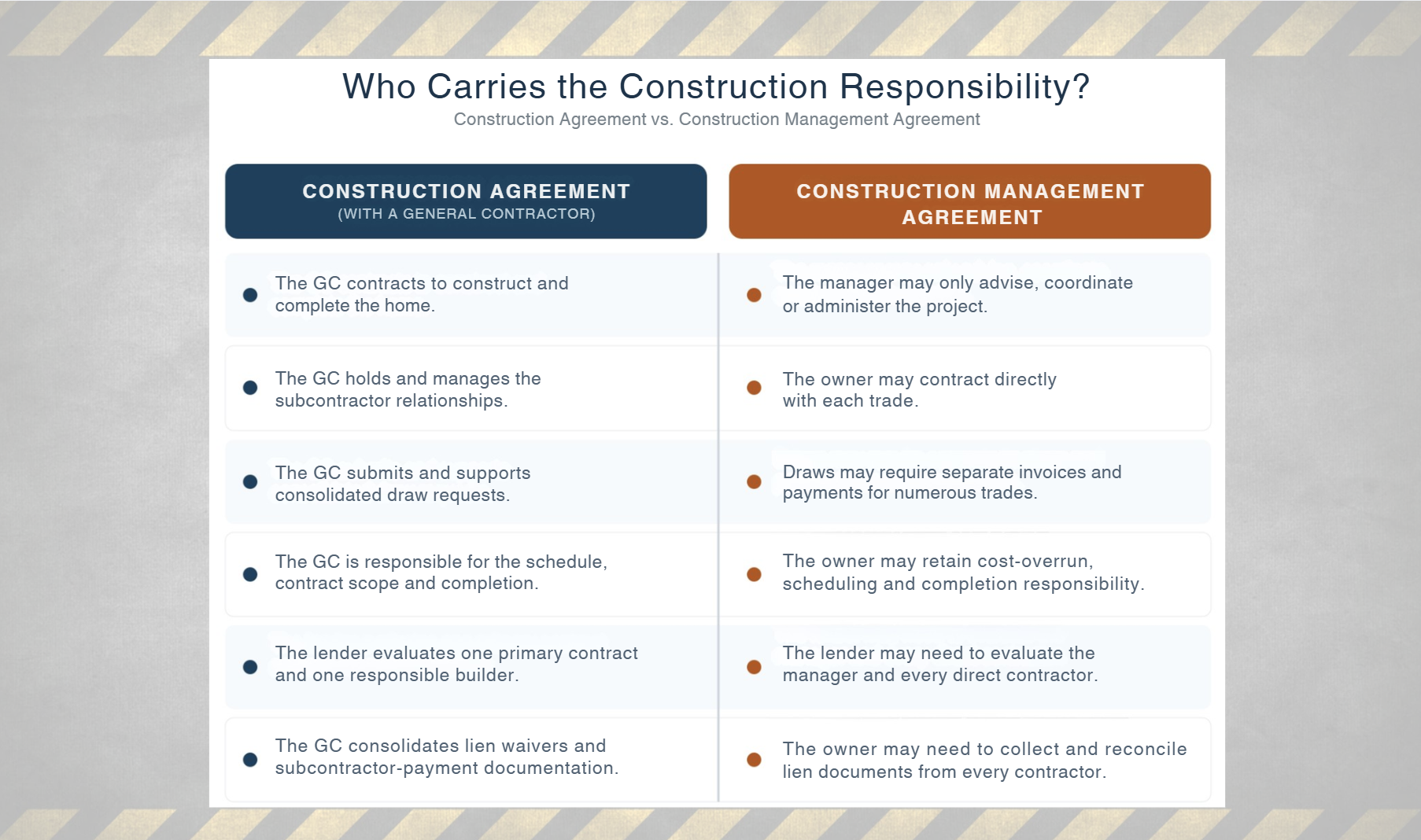
A construction-management agreement can resemble a construction contract if the manager actually hires subcontractors, controls scheduling, purchases materials, guarantees a price or assumes responsibility for completion. Licensing is state-specific. In Arizona, a paid manager performing those functions may be acting as a contractor and may need an appropriate ROC license, regardless of what the agreement is called. In Texas, there is generally no statewide GC license, but local requirements and regulated-trade licenses may still apply.
If the manager is merely an adviser and the owner retains all direct trade contracts and construction risk, the agreement is not the functional equivalent of a full construction agreement with a GC. That distinction can determine whether the project fits a lender’s standard draw, title and contractor-approval process.
The best time to resolve these questions is before finalizing plans, paying large deposits or committing to subcontractors.
Planning an Arizona construction project?
Review the builder structure before you commit.
We can help you review the proposed builder structure, construction budget and financing path early—so you know whether an owner-builder arrangement is workable or whether hiring a licensed GC will create a clearer path to closing.
Discuss an Owner-Builder ProjectReferences
- A.R.S. § 32-1101 — Contractor definitions
- A.R.S. § 32-1121 — Persons not required to be licensed
- A.R.S. § 32-1151 — Unlicensed contracting
- A.R.S. § 32-1158 — Contractor-owner agreement requirements
- A.R.S. § 33-1008 — Lien waiver forms
- A.R.S. § 33-992.01 — Preliminary twenty-day notice
- A.R.S. § 33-1002 — Owner-occupant protections
- A.R.S. § 33-993 — Mechanic’s lien recording
- A.R.S. § 23-902 — Workers’ compensation definitions
- A.R.S. § 23-961 — Workers’ compensation coverage
- City of Austin — Contractor registration
This article provides general educational information and is not legal, insurance or tax advice. Contractor licensing, permitting, insurance and loan requirements vary by project and may change. Verify current requirements with the Arizona Registrar of Contractors, the applicable permitting authority, qualified insurance professionals and your construction lender.