Construction Cost Planning
Building a custom home in Arizona? Recheck your summer budget
If you received a custom home estimate earlier this year, review the assumptions before you sign an agreement. Some construction inputs have risen, others have eased, meanwhile interest rates have gone haywire. Nothing replaces a current project-specific bid.
By Matthew Siket, NMLS #442558 · October 12, 2026 · 8 min read
A construction budget is not one number. It is a stack of bids, allowances, selections, site assumptions, and timing decisions that need to stay connected to the same plans and specifications.
The purpose of this article is to use recent public data as planning context for the same home, plans, and specifications. It does not suggest a universal price change for Arizona construction. Public indicators can help identify questions worth asking. They cannot tell you what a builder, supplier, or lender will offer on your specific project.
Data context only
The figures below are published economic indicators and national survey benchmarks. They are not Arizona supplier quotes, contractor bids, project estimates, lending terms, approvals, or guarantees. Construction inputs vary by location, specification, timing, and project structure. Published data can also be revised.
What the data measures
These sources track different periods and different parts of the construction picture. Arizona construction-industry average hourly earnings provide labor-market context. The material measures are national producer-price indexes, not local supplier quotes or complete installed-bid changes.
That distinction matters. Labor runs through nearly every part of a build. Nonferrous wire and cable is only one part of an electrical bid. Lumber and ready-mix concrete can move independently from a framing or foundation package. A short-term decline in one input does not establish that a whole trade, a full home, or a specific builder's price became cheaper.
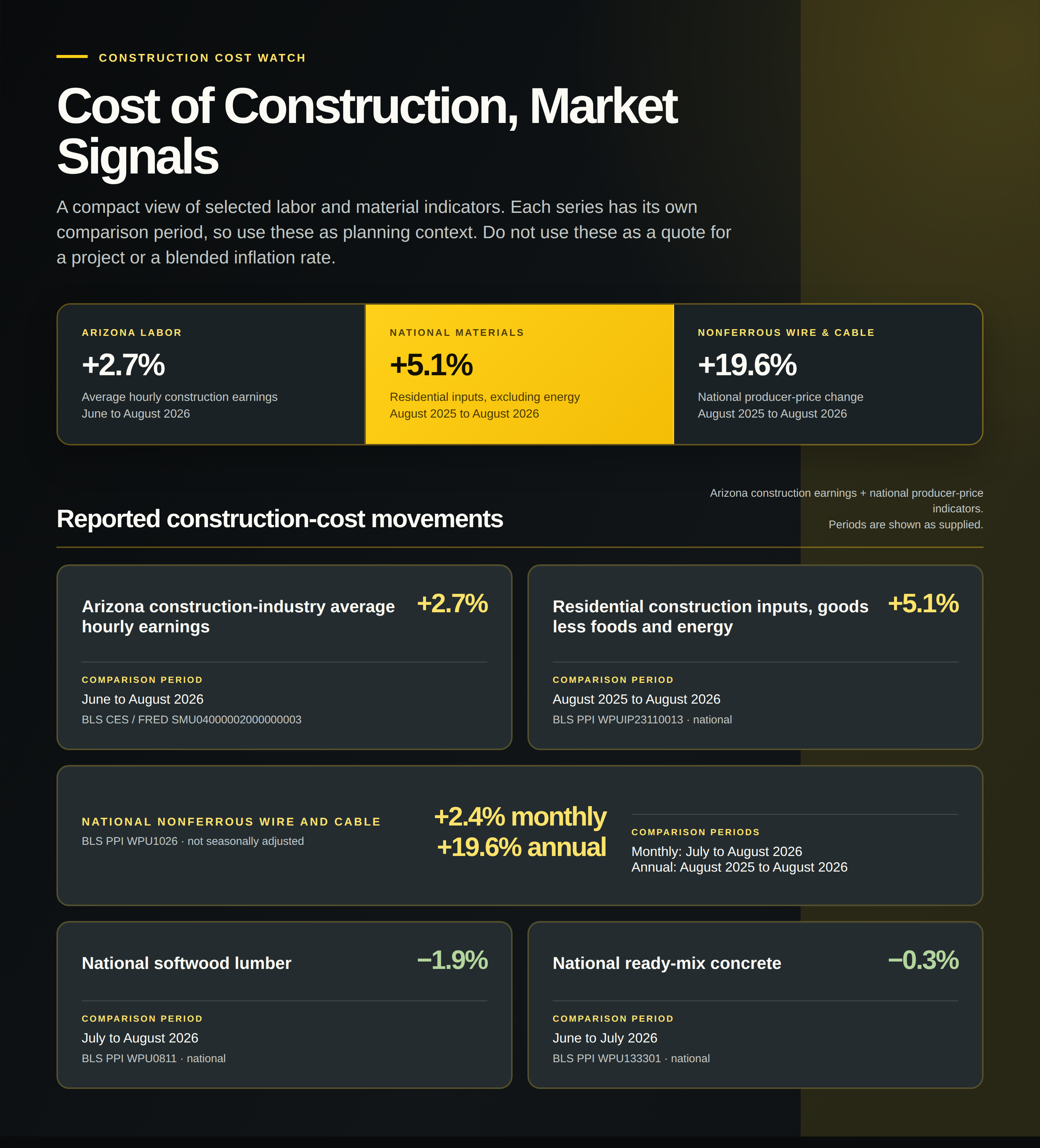
Two corrections are especially important for a planning conversation: the BLS softwood-lumber series was down 1.9% from July to August 2026, while the ready-mix-concrete series was down 0.3% from June to July 2026. Those are different comparison windows, so they should not be blended into one conclusion about a complete framing or foundation package.
For the full series definitions and release context, see the BLS Arizona employment, hours, and earnings data, the BLS Producer Price Index release, and NAHB's analysis of the residential-input data.
What could happen to a $100,000 construction budget?
The following model is an illustration of how several bid changes can add up across a construction budget. It is not a measured change to your own budget since summer or over the past year. The starting shares are an editorial rescaling of the NAHB 2024 Construction Cost Survey, published in January 2025.
NAHB's survey is a national benchmark, not an Arizona custom-home estimate. The illustration excludes land, financing, builder overhead and profit, and the project-specific work that can materially change a real budget. Its purpose is to make one practical point: modest changes across several parts of a build can outweigh savings elsewhere.
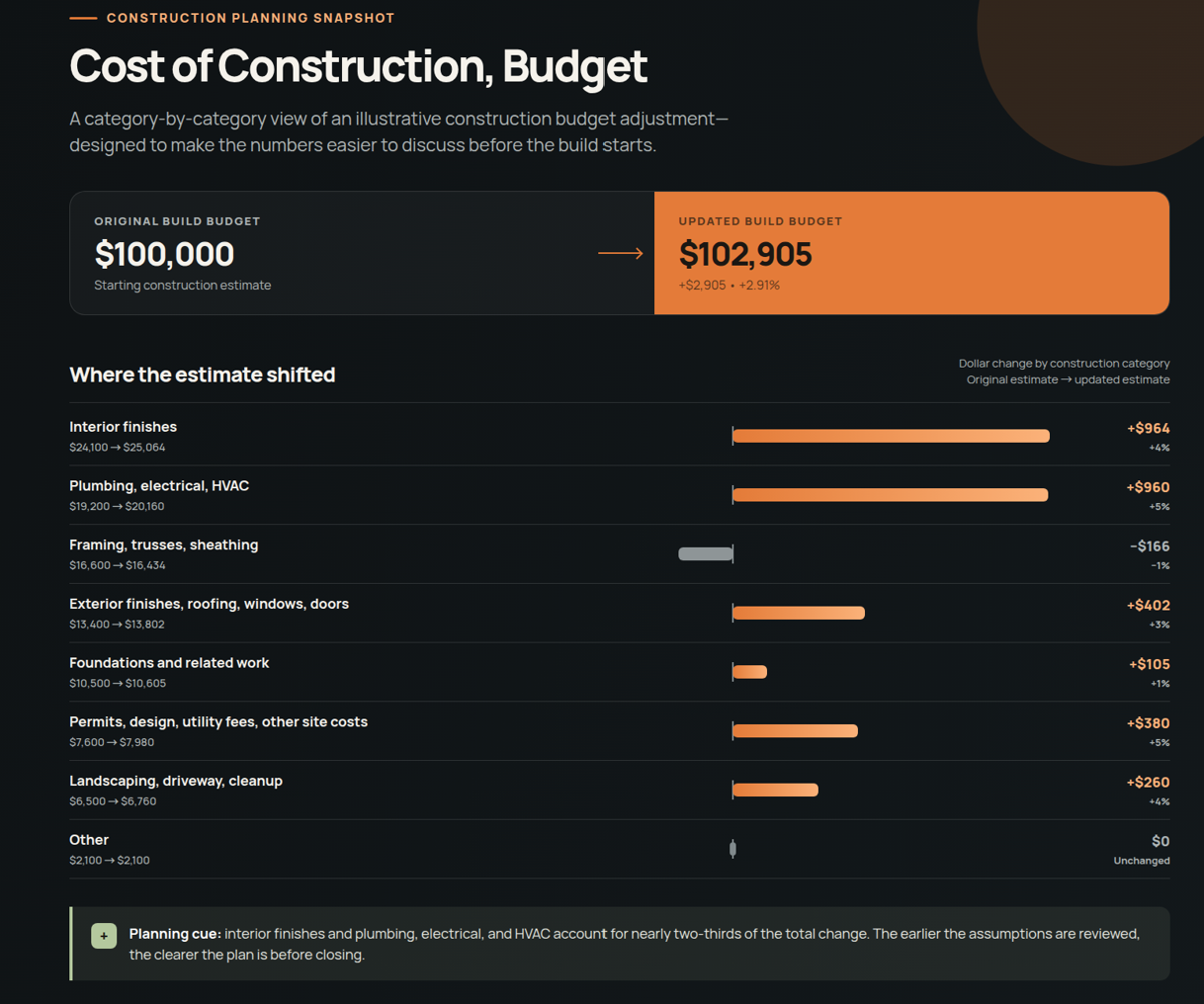
A higher builder estimate is not automatically padding. Ask which bids changed, whether the allowances cover your selections, which materials have been purchased, and what remains unpurchased. For example, a change in one material category affects that category's dollar amount. It does not automatically apply to the entire house.
The useful question is not “Did construction costs go up?” It is “Which line items, assumptions, and decisions changed in this project?” A detailed conversation should connect the plans, specifications, site work, builder agreement, schedule, allowances, and budget in one place.
Keep the complete picture together
Budget, draw schedule, and financing need to tell one consistent story.
Construction planning does not stop with the builder's contract. The land position, project budget, construction schedule, draw process, and permanent-payment expectations all need to fit the structure being considered. Delays, changes in scope, and land financed at closing can all affect the financial picture.
Ask early how the budget will be reviewed against the proposed draw schedule, which costs are outside the builder agreement, what contingencies are available, and which project changes require lender review. Actual financing terms, eligibility, and costs depend on the borrower, property, project, program, and written loan documents.
Build a complete budget and preserve flexibility
A complete project budget should account for the land, builder agreement, design and utility items outside the contract, contingencies, and the financing structure. Review what is firmly priced, what remains adjustable, and which decisions need to be made before you treat the budget as final.
If you are still planning, the editable construction budget worksheet can help organize the line items for a discussion with your builder and lending team. If the project is ready for a serious review, start with the budget, plans, builder information, and construction schedule. It is not only a headline loan amount.
Frequently asked questions
Do the published indicators show what my Arizona custom home will cost?
No. The figures are public economic indicators, not Arizona supplier quotes, contractor bids, installed-cost indexes, or project estimates. Your result can differ based on location, specifications, site work, labor availability, contract terms, selections, timing, and other project factors.
Why are the comparison periods different across the indicators?
Each public series is released on its own schedule and may have a different available observation period. The comparison period must stay next to the figure. A short-term movement in one input should not be treated as a blended construction-cost index or a prediction for an entire home.
What does the national materials measure exclude?
The national residential-input series used here is the BLS producer-price category for inputs to residential construction, goods less foods and energy. It is a national producer-price measure. It does not represent energy, services, an Arizona supplier quote, or the cost of a full construction project.
Is the $100,000 budget example an Arizona construction estimate?
No. It is an editorial illustration that rescales national construction-cost shares from NAHB's 2024 Construction Cost Survey. It is not a quoted budget, an Arizona custom-home estimate, or a forecast. Land, financing, builder overhead, profit, and project-specific items are outside the illustration.
What should I ask my builder before relying on an older estimate?
Ask which bids have changed, which allowances still need selections, what has been purchased or remains unpurchased, how site work and utilities are treated, and which assumptions could change before the agreement is final. A complete answer should connect the plans, specifications, builder contract, schedule, and detailed budget.
Before you break ground, review what is priced, what is adjustable, and what the project still needs.
A complete construction file connects the builder's budget with the plans, schedule, draw process, appraisal, and financing structure. Start that conversation before a decision becomes binding.
Discuss Your Construction ProjectContinue your construction research
Sources
- FRED: Average Hourly Earnings of All Employees, Construction in Arizona (SMU04000002000000003).
- U.S. Bureau of Labor Statistics: Producer Price Index, including series WPUIP23110013, WPU1026, WPU0811, and WPU133301.
- NAHB: Energy Prices Rise Again in August (September 10, 2026).
- NAHB: Cost of Constructing a Home in 2024 (published January 20, 2025).
This article is for general educational purposes only and is not a commitment to lend, a rate quote, or personal lending, legal, tax, appraisal, or financial advice. Loan availability, underwriting, eligibility, construction terms, pricing, and documentation requirements can change and vary by borrower, property, project, and lender.